

| The Gondola and its history |
| Using the Gondola |
| Bibliography |
| Press release |
| Itineraries |
| News |
| Links |
| Contact us |
| Postcards from Venice |
| Guest Book |
Capitolo 2 The smaller shipbuilding activity in Venice
2 - The dispute between public and private initiative
pag. 1 2 3 4
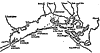 The lagoon in the fourteenth century | The genesis of the boats and the lagoon-ships lasts certainly centuries, fruit of generations and generations of builders that bring, each, an improvement. While for the cargo ships the squerarolo inherited, in the Dark Ages, the technique knowledge of the Byzantine, for the shore building he projected original models: it was the lagoon itself that with its shoals, its narrow canals, the sudden obstacles, suggested the form and dimension most suitable of the boats. | |
 The "cocche" were round sailing ships, the rowing and sailing galere | Initially the shipyards take spaces in all the city and also on the shores of the Grand Canal,as Gian Battista Galliccioli remembers:".. till the beginning of the Nation they were built crafts in Rialto... but since when the Ducale Site was moved here the squadri increased, or places to make crafts by us called Squeri." S'abboni poi una certa velma non lungi da San Marco e fu chiamata Terranova, ove si fece un arsenale, per fabbricarvi Coche e Galere..." The cocche were merchant round ships, used , that is to say, for the goods transport. The galleys, on the contrary, were born as subtle and speedy, more adapt to the fight, were then adapted to transport ships; around 1300 they became "trireme" and increased their dimensions: if the first carried only 50 tons, in 1320 one was built of 150 tons! Venetian Government recommended to use the galleys, put together in trains to defend themselves better from pirates or other assailants. in the galleys,in fact, they travelled also armed men. | |
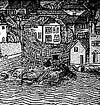 A "squero" for ships in St. Marta | It is around 1300 and the squeri, in that period, built indifferently crafts of every kind for private shipowners and public ships for the government. The new city address involves the social outcasting of the activity of building ships in suburban areas and minor rii. The policy of the Venetian Senate, in the attempt to improve the productivity of the arsenal, assuring to the shipyard of state the best workers, penalizes hardly the "squeraroli de fora", that is those who did not work inside the arsenal. But the private sailing craft is a trained competitor of the trains of public galere, that enjoy big state subsidies! | |
